Jules is retiring. Google announced the turndown on October 29, Jules went read-only on November 11, and on December 31 it’s gone. What Google learned from it is going into Antigravity, its newer agent platform.
I used Jules regularly. I’ll miss the free tier, but happily, the rest lives on: Antigravity’s web interface is great. And Jules deserves a proper send-off. Not because it was the smartest agent around– it didn’t need to be. Because it let me fix things from wherever I was, without needing to run a backend anywhere.
And Jules got there first… well, early. Google showed it to trusted testers in December 2024, months before OpenAI’s Codex moved to the cloud. But Codex launched first, on May 16, 2025, as a research preview for paid ChatGPT plans, four days before Jules’s free public beta. GitHub’s Copilot coding agent arrived the same week. Jules did reach general availability first, though: August for Jules, October for Codex. (Devin beat everyone, back in March 2024. But it sat behind a waitlist until December, then cost $500 a month.) What set Jules apart was the price of entry: free, for everyone, no waitlist.
Let’s look at what made it work, why Google’s other tools didn’t quite get there, and where it went in Google’s lineup.
The pattern went like this: I’d be mulling over a problem and an idea would hit me. Previously I’d need to take a note and try later. But with Jules, I could send a short message and the code was on its way. And sometimes I’d spot an issue with a quick, obvious fix and want to ‘fire and forget’ the solution.
Here’s an example: I was looking at a timeline chart in my app and struggling to find “today”. So I asked Jules to add a vertical line marking today. Done. That was November 8, three days before Jules went read-only. The next day, I submitted my last-ever Jules task: add light/dark mode & follow the system theme.
Sometimes I’d work end-to-end on my phone. Other times I’d start at my desk, then fine-tune the code during review on my phone, wherever I happened to be.
Most coding agents take care of the code itself, plus the ceremony around a change: managing branches, setting up development environments, running tests, submitting PRs, reacting to feedback. Jules did that but with a critical addition: minimal friction. More friction means a higher likelihood that ideas get lost in a sea of TODOs, to be addressed “later”, which is too often a polite word for “never”.
Jules achieved this with three properties:
- Serverless. The work ran on a short-lived VM in Google’s cloud, not on a machine of mine. Nothing to own, configure, or keep plugged in.
- Asynchronous. I described the task and walked away. Jules cloned the repo, made a plan, did the work, ran the tests, & opened a PR without me watching.
- Mobile-friendly. I could work on my phone, from task launch to PR merge, whenever and wherever the idea hit me. And without squinting at VS Code in a phone browser.
Drop any one, and the quick fix goes into the TODO pile. If it needs a server, I need to dedicate a machine. If I have to work synchronously, I might as well do it myself in my well-functioning local environment. And if it doesn’t work on a phone, that’s friction between having the idea and starting the work.
Google had several other agents, but Jules stood out for my use case.
Firebase Studio (née Project IDX) is serverless: a cloud VM with an editor and a Gemini agent. But it’s a proper IDE you sit in and work with, and a full IDE in a browser tab isn’t exactly mobile-friendly. It’s also being retired.
Antigravity’s Remote Control, added in August, is asynchronous and mobile-friendly: you can start and check on agents from your phone. But the agent runs on a machine you provide (e.g., your laptop, or a headless VM like Compute Engine), which has to stay on and awake. That’s self-hosted with a remote: not serverless.
Beyond those three properties, Jules was surprisingly good at navigating software build environments. I used it for many languages: Python, Kotlin, Javascript, Ruby, TypeScript, CSS, HTML; and many frameworks: Firebase, Cloud Run, Django, Angular, Textual, Eleventy.
Jules particularly impressed me by figuring out a Kotlin Multiplatform project: an Angular frontend embedding JavaScript compiled from Kotlin. I never wrote a setup script.
Asynchronous has a catch, though: nobody’s there when the agent gets stuck. At the end of May, my stratum project required Python 3.14, and Jules’s sandbox only had 3.12 out of the box. The “obvious” move is to install 3.14 using pyenv. Jules instead lowered my project’s requirement to 3.12 “to match the current stable environment”. Agents gonna agent: the PR blamed “CI failures” on 3.14 but my local tests ran 3.14 just fine. Yet six weeks later, in two other Python repos, Jules ran pyenv install 3.14.0, no fuss. Changing the project to fit the sandbox was a surprising first reach versus configuring the sandbox. On my own computer, 3.14 was already installed. In a sandbox, the agent has to set it up, and nobody’s watching when it doesn’t.
In six months, Jules opened 80 PRs across 10 of my repos, and I merged 73. It scaffolded whole projects, kept CI current, and shipped several features. One PR, Make side drawer responsive, was followed by Revert 'Make side drawer responsive'. Oops.
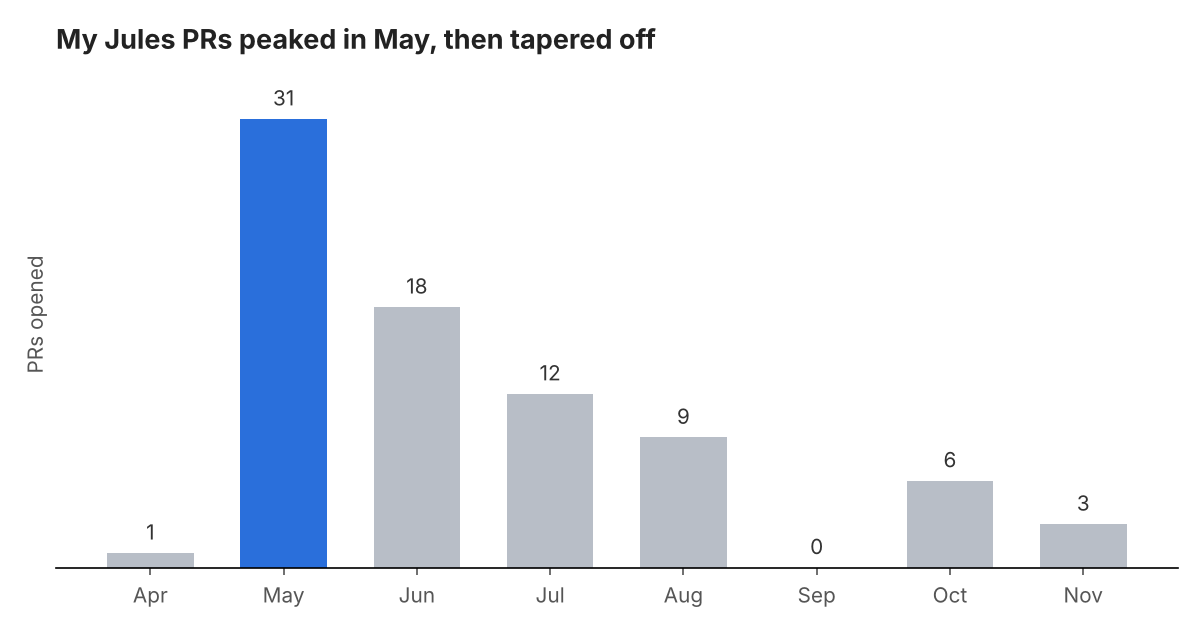
Why the taper after May? In June I got busy with a client who had their own AI agents. Besides, Google only offered Jules to personal (Gmail) users, not Workspace accounts. When I learned Google was shutting down Jules in late October, I rushed to get a few last things done before it went away.
Enter Antigravity Remote Agents, which started rolling out November 3, five days after the Jules announcement. The agent runs in a Google-managed environment, keeps working after you close your laptop, and you drive it from antigravity.google.com in a phone browser, no app required. Serverless, asynchronous, mobile-friendly. And the mobile interface is solid.
So I gave it the hard case: I pointed it at that weird Kotlin Multiplatform project and asked it to fix mobile rendering issues. It worked out of the box– Gradle, Kotlin/JS, the Angular app, all of it. That’s pretty cool.
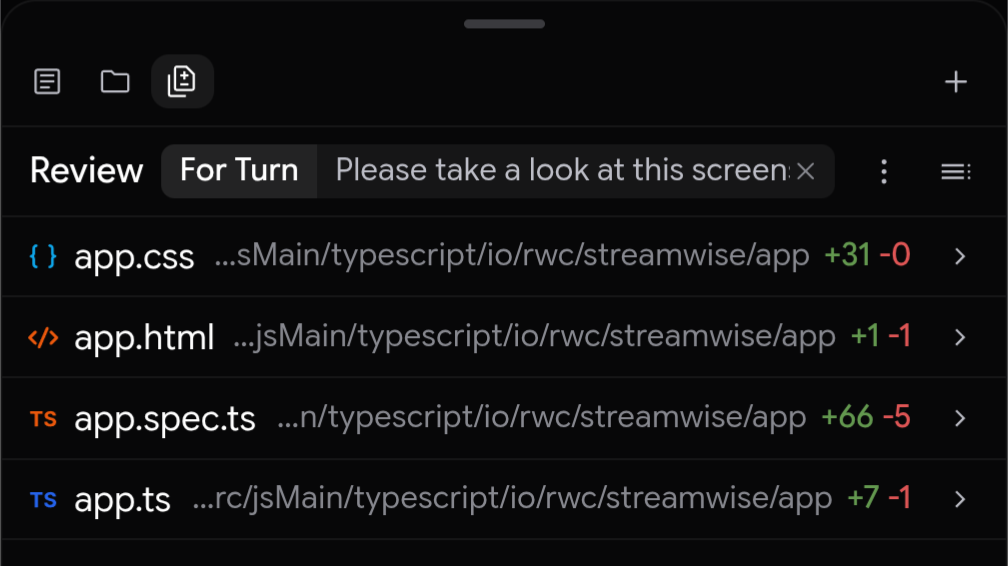
Reviewing on a phone works, too. The review screen lists each changed file with its line counts, and you can expand or hide each diff. You can’t check a file off as viewed, though, which you start to miss on a bigger change. I also find Remote Agents doesn’t open a PR without some additional poking.
Remote Agents improves on Jules, too: each Jules task got a fresh VM, while Remote Agents keeps projects, conversations, & uploaded files between sessions. On the other hand, the docs don’t say what’s installed or how the environment gets set up. That’s left to the agent to figure out.
Jules lived entirely in the cloud and never had a desktop side. Cursor and Claude Code came at this from the opposite direction: desktop tools that grew cloud agents and a web & mobile front end, so the same work moves between your phone and your desk. Antigravity had the desktop app but no cloud agents. Now it has both, and I can start a fix on my phone and pick it up at my desk without missing a beat. That matters, because small fixes start fine on a phone, but for deeper work I’d still rather be at a desk. On the desktop side, Google is the one catching up.
What got lost from Jules to Antigravity is the price of entry. Anyone could use Jules for free, 15 tasks a day. Remote Agents needs a paid Google AI Pro ($19.99 a month) or Ultra plan. Unfortunately, as with Jules, Workspace accounts aren’t supported yet.
If you use Jules, export your data before December 31. Google isn’t moving it to Antigravity for you.
So Jules retires, and Remote Agents takes over the work. I’m happy I can still code from my phone … it just has a price tag now. 💰
I help teams make slow, expensive, or fragile software fast, cheap, and reliable. Let’s talk.